


Do You Need to Prove Anything to Make Music?
For the past few years, every week I have seen young people walk into Plug The Jack studios for the first time.
Some arrive with friends. Others come alone. Some have been making music for a few years, while others are starting almost from zero.
With DJs, this is particularly visible. You can love music deeply, spend hours listening to sets, start mixing at home and still feel very small when you stand in front of a pair of CDJ-3000s and a professional DJ mixer for the first time.
There is sometimes a strange feeling that this kind of equipment is meant for “real DJs”. As if you need to have reached a certain level before you belong behind it. Yet our DJ studios welcome people of every level, including those who are just starting out.
But at what point do you become a real DJ? A real musician? An artist?
After several years spent around thousands of people who make music, I am no longer sure those questions are particularly useful.
“I’ve always been terrible”
In the early days of Plug The Jack, I met a man of around seventy who used to come and play in our studios.
I asked him how long he had been making music and which band he played in.
His answer stayed with me.
He told me that he had been playing for a very long time, that he had “always been terrible”, but that he simply could not imagine how his life could be happy without music, without those moments spent playing with his friends and expressing himself.
His answer made me smile. But over time, I realised that it said something quite profound.
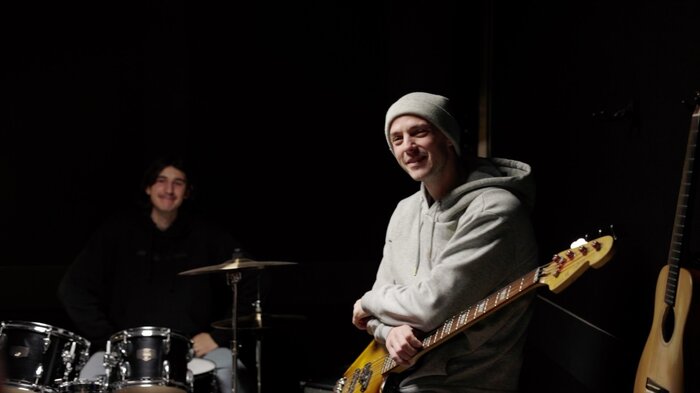
At one end of the spectrum, I see eighteen- or twenty-year-olds hesitating to think of themselves as musicians because they are just beginning.
At the other, this man had played for a large part of his life, still did not consider himself particularly good, and it did not matter in the slightest.
Somewhere between the two lies a fairly simple idea: we probably give far too much importance to level when deciding who has the right to make music.
Being a musician is not a level
We tend to associate music with performance.
You become a “musician” once you reach a certain level. “Artist” can feel even more intimidating: the word sometimes seems reserved for people who have acquired a certain legitimacy, perform in front of an audience, release music or make a living from it.
Yet that is not what I see.
The vast majority of people who come to Plug The Jack do not make a living from music. And many of them are not even trying to.
Music simply occupies an important place in their lives.
It allows them to create, meet other people, share something and express themselves. Sometimes it is even part of how they define themselves. That is also the idea behind the mission of Plug The Jack: making musical expression accessible, whatever your level.
Being a musician may therefore not really be a question of level.
It begins with having a relationship with music.
Sincerity before perfection
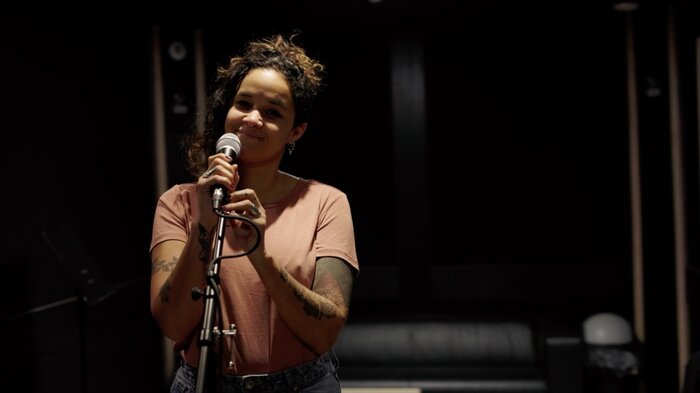
There is one word that feels particularly important to me: sincerity.
Someone can express themselves awkwardly and still communicate an enormous amount. On the other hand, someone can master a formula perfectly and communicate almost nothing.
Imperfections, hesitation and even a certain vulnerability are part of artistic expression.
A seventy-year-old man can be clumsy with his guitar and still communicate an incredibly infectious passion.
Because music is, above all, a language.
It allows us to say something, but also to meet other people around that something.
And when there is sincerity in what we play, sing, compose or mix, technical level stops being the only criterion that matters.
At Plug The Jack, this is precisely what we try to make simple:
having an equipped space where you can practise alone or with others, without already needing a certain level or having to own all the equipment yourself. Discover Plug The Jack
So why practise?
None of this means that technique is useless.
Quite the opposite.
If music is a language, working on your technique is a way of expanding your vocabulary.
A writer may naturally have something to say. But reading, learning, discovering new words and understanding how other people write will gradually give them more ways to express exactly what they want to say.
Music works in much the same way.
You practise your parts. You develop dexterity on a guitar. You learn to use your voice. You discover what a mixer or a piece of software can do. You learn from other people.
Every additional skill adds another colour to your palette. For a beginner DJ, that may simply mean spending time practising and gradually becoming familiar with the equipment. For a band, it may mean meeting regularly in a rehearsal studio. For a singer, beatmaker or producer, it may mean experimenting in a recording and production studio.
Technique is therefore not necessarily a destination. It is a tool that gives us more ways to express what we want to say.
And what matters remains the music itself.
Making room for music
There is, however, one very practical difficulty: making room for music in our lives.
Of course, you can make music almost anywhere. You can hum in the car, write down a few words when an idea comes to you or play at home.
But some forms of practice require space, volume, equipment or simply several people.
And in urban life, between work, studies, shared homes, neighbours, travel and constant demands on our attention, bringing all those conditions together is not always easy.
That is also why I like the idea of a studio as a kind of hideaway or refuge.
A place where, for an hour or two, there is almost nothing left to organise. The equipment is there. The space is there. The other musicians can be there.
And you can simply focus on music.
Not because you necessarily have to improve. Not because you have to prepare for a career. But simply because you have decided that music deserves that place in your life.
You do not need to wait until you are a musician
If you look at a guitar, a microphone, production software or a pair of CDJs today and think that you probably are not good enough to be there yet, you may be looking at the problem the wrong way around.
There is no minimum age or level required to start exploring something you care about. Over a lifetime, we discover different passions and follow different paths.
Music does not impose a standard level you have to reach before you have a place in it. Anyone can learn, meet other people and progress at their own pace.
And meeting other musicians also reveals something reassuring: they are learning too.
Perhaps music ultimately asks for a little humility. An acceptance that it is bigger than our level, our technique or our ambitions.
And then you start.
Because you do not need to wait until you are a musician before you start making music. Perhaps making music is how you become one.
Damien
Founder of Plug The Jack
