


Mixing and mastering: what’s the difference?
When you start producing your own music, the terminology can get confusing very quickly.
You record a vocal, change its level, add EQ and reverb.
Are you still recording?

Are you already mixing?
And when does mastering begin?
The difference becomes much clearer when you look at what you are actually working on at each stage.
Recording creates the material.
Production builds the track.
Mixing makes the individual tracks work together.
Mastering treats the finished song as a whole.
In real projects, the boundaries between the first three stages are not always perfectly clear. But this distinction helps you understand what you are actually trying to achieve.
Recording: creating the raw material
Recording is first of all about capturing a sound.
A vocal through a microphone.
An instrument.
An amplifier.
Or any other audio source.
At this point, your main goal is not yet to make the entire song perfectly balanced.
You are mainly trying to create good raw material.
A clean enough take.
A sensible input level.
No unwanted clipping.
A consistent position in front of the microphone.
As little unwanted noise or room reflection as possible.
This matters because a poor recording will follow the song throughout the rest of the production.
You can use EQ, compression and other processing later, but no plugin can perfectly recreate information that was never captured properly in the first place.
If you want to go deeper into this first step, our Guide How to record your first song covers the basics of making a first recording.
Production: building the song
Recording is only one part of music production.
You can start producing before you have recorded anything at all.
A beat.
A few chords.
MIDI.
A virtual instrument.
A sample.
A first structure.
Then you add a vocal and change the instrumental because that vocal changes the way you hear the track.
Production therefore involves much broader decisions:
- which elements to use;
- when they appear;
- when they disappear;
- how the song develops;
- which sounds to choose;
- which takes to keep;
- what kind of atmosphere you want.
That is exactly why it can sometimes be difficult to say where production ends and mixing begins.
Mixing: making all the tracks work together
At a certain point, your song exists.
You roughly know:
- which elements are going to be used;
- what the structure is;
- which takes you are keeping;
- how the vocal fits into the track;
- how the different sections connect.
The main question now becomes:
How do I make all of this sound good together?
That is the role of mixing.
When you mix, you are not only working on “the sound of the song”.
You still have access to the individual tracks.
For example:
- the vocal;
- the rhythm;
- the bass;
- melodic elements;
- instruments;
- effects and other tracks in the project.
You can therefore still make very specific changes to each of them.
Volume is already part of mixing
Mixing often starts with something very simple: levels.
A vocal may be too quiet.
A bass may be too dominant.
A secondary element may be drawing far too much attention.
Before using a single plugin, the faders already allow you to build a hierarchy.
What needs to be in front?
What can stay further back?
Which elements need to be clearly heard, and which ones simply need to contribute to the whole?
A good mix does not mean every track should be heard in the same way.
It means that each one has a place that suits its role.
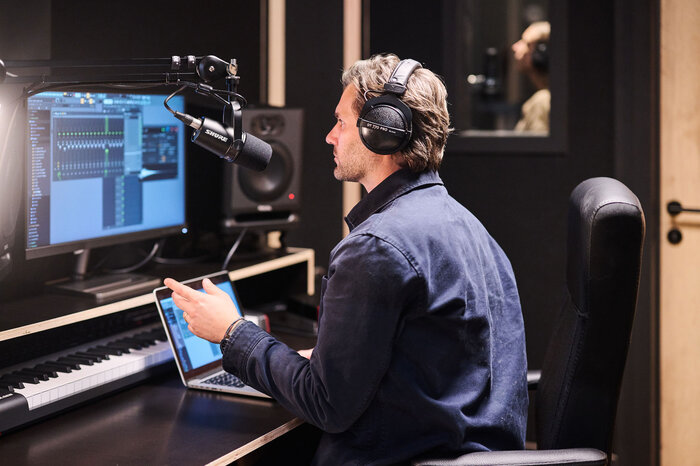
EQ, panning and compression help refine that balance
Once the levels begin to work, other tools can help refine the mix.
EQ works on frequencies.
It can help when several elements are masking each other or when a track is taking up unnecessary space in parts of the frequency spectrum.
Panning places certain elements more towards the left or right and helps build the stereo field.
Compression can help control variations in dynamics.
Reverb and delay can create depth, space or an artistic effect.
But all of these tools have one thing in common:
they should serve the song.
Automatically putting EQ, a compressor and three effects on every track is not mixing.
Mixing means identifying what the song needs and making changes for a reason.
Production and mixing can overlap
In a perfectly organised world, you could imagine:
I completely finish my production.
Then I stop changing anything and start mixing.
That is not how many modern projects actually work.
While producing, you are already adjusting levels.
You put EQ on a sound.
You may compress a vocal.
You add a reverb that becomes an important part of the identity of the song.
In other words, you are already mixing a little while you produce.
And during the mix, you may discover that a problem is not really about sound at all, but about arrangement.
Are two elements constantly getting in each other’s way?
A more complex EQ may not be the best solution.
Maybe one of them simply needs to disappear during certain sections.
The boundaries are therefore useful for understanding the purpose of the work, not for imposing a rigid method.
How do you know when your mix is finished?
This is obviously one of the hardest questions.
A mix can always be changed.
Another 0.5 dB on the vocal.
A little less bass.
A different reverb.
A slightly different EQ.
At some point, though, you have to stop.
A mix is developed enough when the important elements have found their place, nothing is obviously bothering you and the song matches the intention you are aiming for.
A useful test is to listen in several situations:
- your usual monitors;
- headphones;
- possibly some smaller speakers;
- at low volume;
- after a break, when your ears are fresher.
The goal is not for it to sound exactly the same everywhere.
But it should remain understandable and coherent.
A sufficiently accurate listening environment also helps you make better decisions. That is one of the purposes of a properly treated recording and production studio.
At the end of the mix, the tracks become a stereo file
This is where the distinction between mixing and mastering becomes much clearer.
During the mix, you could still turn down only the vocal.
Change only the bass.
Adjust the reverb on one track.
Move an element in the stereo field.
Once the mix is exported, all of those tracks are usually combined into one final stereo file.
And in most workflows, that is the file that then goes to mastering.
Mastering: working on the song as a whole
Mastering therefore comes at the end.
The song is no longer a collection of separate tracks.
Mastering mainly works on the complete mix.
That changes the available options significantly.
If the vocal is too quiet in your stereo file, mastering no longer gives you a simple “vocal” fader that you can turn up.
The vocal is now part of the same file as everything else.
That is exactly why mastering should not be treated as a way to repair a bad mix.
%20(1).jpg)
What is mastering actually for?
Mastering can help finalise:
- the overall tonal balance;
- the overall dynamics;
- the final level;
- the overall spectral balance;
- the coherence of the track;
- how well it translates across different listening and playback systems.
For an EP or album, mastering also helps create consistency between several songs.
The tools may look similar to those used in mixing — EQ, compression, limiting, metering — but the perspective is different.
During mixing:
How does the vocal work against the music?
During mastering:
How does the entire song work as a finished product?
That change in perspective is what really matters.
Mastering is not simply about making the song louder
This is a very common misconception.
You finish a mix.
It sounds quieter than a commercial release.
So you add a limiter until it becomes much louder.
And you call that mastering.
Final level is genuinely part of the process.
But louder does not automatically mean better.
Overly aggressive mastering can reduce dynamics too much, introduce distortion or make the song tiring to listen to.
The goal is to find a balance between level, dynamics, spectral balance and sound quality.
Mastering does not rescue a bad mix
This is probably the most important point to remember.
If your vocal is genuinely too quiet, go back to the mix.
If a track is clipping, go back to the mix.
If the bass is masking everything else, go back to the mix.
If the arrangement is too busy, you may need to go even further back: to production.
Mastering is the final finishing stage, not a process designed to turn a project that still does not work into a finished song.
Should you mix and master your own music?
To learn: absolutely.
Mixing your own songs teaches you a huge amount about:
- recording;
- arrangement;
- frequencies;
- dynamics;
- space;
- and the decisions you make during production.
The same goes for mastering: trying it yourself helps you understand what it is actually doing.
But that does not mean you always have to do everything yourself.
Another engineer can bring:
- more experience;
- a more trained technical ear;
- a more accurate listening environment;
- and, above all, fresh ears.
After spending dozens of hours on the same song, it becomes difficult to hear it with enough distance.
Bringing in someone else can therefore be an artistic choice as much as a technical one. Plug The Jack can also connect you with independent sound engineers and producers to work with on your project.
A simple way to remember the four stages
Whenever the terminology starts to blur again, come back to four questions.
Recording: what am I capturing?
I am creating the raw material.
Production: what am I building?
I am deciding on the elements, sounds, structure and development of the song.
Mixing: how do the tracks work together?
I balance them, create space and build the overall sound from the separate tracks.
Mastering: how does the finished song work as a whole?
I work on the completed mix and prepare the final version for release and playback.
In reality, the boundaries can overlap.
But the basic idea remains very simple:
you record the elements, build the song, make the individual tracks work together, and then finalise the whole thing.
Damien
Founder of Plug The Jack
