


Your first band rehearsal: how to prepare
Playing on your own at home and playing with other musicians are two very different experiences.
You may know your guitar, bass, drum or vocal part perfectly and still discover within the first few bars that everything changes once the whole band starts playing. You have to listen to the others, find your place, follow the group's tempo, manage the overall sound and keep going even when everything isn't perfect.
That's exactly what makes a first rehearsal so interesting.
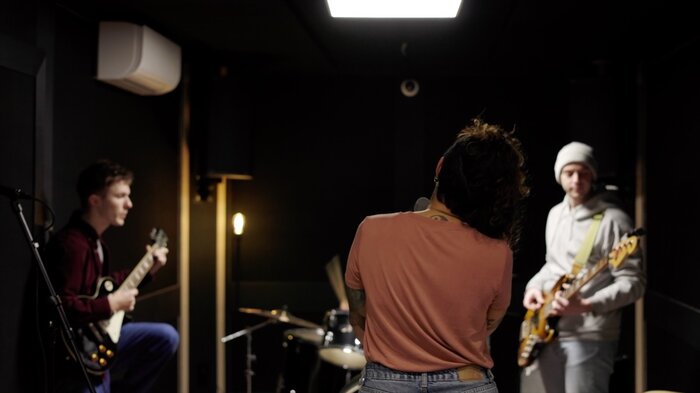
The goal isn't to prove that everyone has mastered their instrument. It's much simpler: start making music together and leave wanting to do it again.
Choose two or three songs before the rehearsal
There's no need to prepare a list of fifteen songs for your first rehearsal.
Instead, choose two or three songs everyone enjoys and that are manageable for each member of the band.
That last point matters. The ideal song for a first rehearsal isn't necessarily the most impressive one. It's one the band has a reasonable chance of making work fairly quickly.
If everyone is already using all their concentration just to get through their own part, there won't be much attention left for listening to everyone else.
With two or three relatively straightforward songs, you can play them several times, start finding a balance and, most importantly, experience fairly quickly what makes playing in a band so rewarding: hearing a song come together with real musicians around you.
Practise your own part before you arrive
This is probably the most important piece of advice in this guide.
A band rehearsal isn't the best place to learn the notes or chords of your own part from scratch.
Of course, nobody needs to arrive knowing everything perfectly. But everyone should know their part well enough to be able to play the song with the rest of the band.
The reason is simple: a rehearsal uses everyone's time.
If four musicians know the song but the bass player is still searching for the right notes, or the guitarist constantly has to stop the band to find the next chord, it isn't only that musician's time being used. Everyone else is waiting.
The singer is often especially affected by this. They may know their part perfectly but still be unable to really work with the band until the instruments can get the song moving together.
Individual practice prepares the rehearsal. Rehearsal is for working on the things you can't work on alone.
That means listening, keeping time together, transitions, dynamics, arrangements and the way all the individual parts work as one.
Take a few minutes to arrive together
A rehearsal doesn't have to begin with the first note.
Take a few minutes to settle in and reconnect with each other.
Some band members may be arriving after school, work or simply with very different energy levels. A few minutes to talk, see how everyone is doing and remind yourselves what you want to play can change the atmosphere of the entire session.
You're not just four or five instruments standing in the same room.
You're people trying to create something together.
There's no need to turn this into a formal meeting. Just agree on a few simple things:
- which songs you want to play;
- which one you'll start with;
- whether there's a particular section someone wants to work on;
- what you'd like to have achieved by the end of the rehearsal.
Then get set up and start playing.
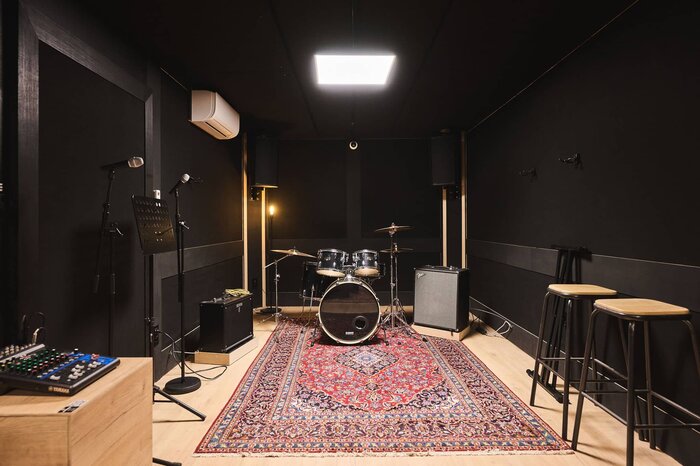
If you rehearse at Plug The Jack, you can also check what is already in the room and what you need to bring before your session.
Find a simple sound balance before you play
You need to hear each other in order to play together.
Take a few minutes to find a simple balance between the instruments. With an acoustic drum kit, the natural volume of the drums will often be the starting point. Set the amplifiers and vocals around that so everyone can hear each other without getting into a volume war. The drummer can of course adjust their playing dynamics too, but the aim isn't to turn a first rehearsal into a complicated soundcheck.
You don't need to achieve the perfect concert or recording sound straight away.
At first, just ask a few basic questions:
- Can everyone hear the other musicians well enough?
- Can you hear the vocals?
- Is one amplifier overpowering the whole band?
- Is the overall volume comfortable?
If the answer is yes, play.
A common trap is for everyone to start playing on their own, often quite loudly, to check their instrument or show what they can do. But playing in a band actually starts with the opposite: listening to what everyone else is doing and finding your place among them.
If volume or positioning becomes a problem, read how to hear each other better in rehearsal.
Start a song and try to make it to the end
You start the first song.
The guitarist misses a chord in the eighth bar.
Does everyone need to stop?
Not necessarily.
If the band can keep going, keep going.
A small mistake doesn't automatically need to result in stopping, discussing it and starting again.
When you play with other musicians, learning how to recover from a mistake is part of the skill. It also allows you to preserve the energy and movement of the song.
If you stop every thirty seconds, it becomes very difficult to experience how the song works as a whole.
So whenever possible, try to make it to the end.
You can come back to what went wrong afterwards.
Work on the problems after you've played the song
Once the song is finished, take a few minutes to identify what caused problems.
Maybe:
- the transition from verse to chorus isn't working;
- someone keeps speeding up;
- the vocals disappear when all the guitars come in;
- two musicians don't start at the same time;
- one section still isn't well enough known;
- nobody is quite sure how the song should end.
This is where the rehearsal becomes genuinely useful.
Go back to the section that caused trouble. Play it several times if necessary. Try another approach.
But also learn to distinguish between what needs to be worked on by the band and what someone needs to practise individually.
If a transition between everyone isn't working, work on it together.
If one musician simply doesn't know their part well enough yet, it's often more effective for them to practise it at home before the next rehearsal.
That distinction prevents future rehearsals from becoming individual practice sessions with four other people waiting around.
Listen to the band, not just your own instrument
When you first start playing with other people, it's natural to focus heavily on your own part.
You're trying not to lose the tempo, forget the notes or make a mistake.
But gradually, your attention needs to shift.
You need to start hearing:
- where the drums are;
- what the bass is doing;
- when the vocals come in;
- what the other instruments are playing;
- and, most importantly, what the band as a whole sounds like.
A good band sound doesn't necessarily come from five musicians each playing perfectly and as loudly as possible.
It appears when everyone starts understanding where they should take up space and where they need to leave space for someone else.
Playing in a band isn't playing your own part next to four other people.
It's playing together.
Two hours is plenty for a first rehearsal
For a first rehearsal, two hours is a good amount of time.
It gives you enough time to:
- arrive and get set up without rushing;
- find a simple sound balance;
- play your two or three songs;
- identify difficult sections;
- work on those sections;
- play the songs again.
A much longer session isn't necessarily more productive, especially while you're still discovering how the band works together.
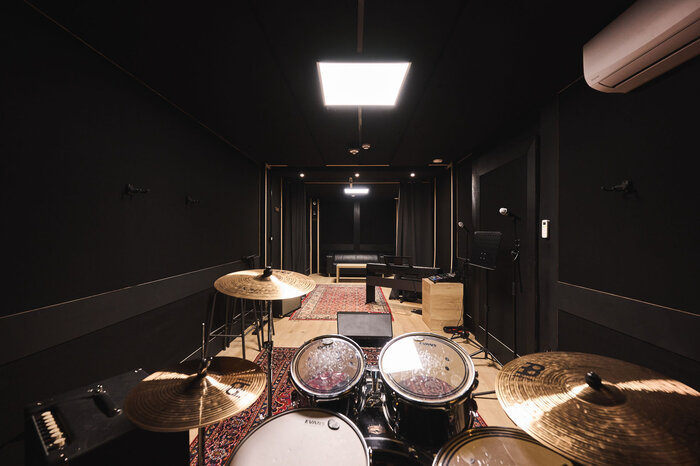
Using a fully equipped rehearsal room, with drums, amps and PA already in place, also lets you spend more of that time playing instead of setting up gear.
After a while, concentration drops and your ears get tired.
It's better to finish after two hours wishing you could play one more song than to turn your first rehearsal into a marathon.
Don't spend the whole rehearsal talking
Discussion is necessary.
You'll probably talk about songs, arrangements, mistakes and what you want to do next.
But try not to use a large part of your rehearsal time making decisions that could just as easily be discussed afterwards.
When the two hours are over, you can always spend another half hour together.
Ask yourselves a few simple questions:
- What worked well?
- Which songs do you want to keep working on?
- What was difficult?
- What should each person practise before the next rehearsal?
- Which new song could you add?
- When are you going to play together again?
A short debrief like this can make the next rehearsal much more productive.
Once the band starts rehearsing regularly, go further with How to rehearse effectively as a band.
What if something goes wrong?
That's normal.
The tempo might move around. A guitar may be too loud. Someone may forget their part. The whole band might completely lose track of where you are in the middle of a song.
A first rehearsal isn't an audition, and it certainly isn't a concert.
It's there precisely so you can discover everything that changes when several musicians start playing together.
The important thing is that everyone has the chance to take part, try things, make mistakes and be heard.
If everyone starts out mainly trying to show what they can do, a rehearsal can quickly become frustrating.
If everyone instead tries to make the song work with the other musicians, individual skill level becomes much less important.
The real goal of your first rehearsal
Your first rehearsal should above all make you want to have a second one.
Choose songs you can realistically play. Arrive reasonably prepared. Take a few minutes to settle in together. Find a simple sound balance. Play the songs through whenever you can, then work together on what isn't working yet.
There will probably be mistakes.
That's fine.
Because somewhere among all those small imperfections, something much more important can happen: for a few bars, the drums, bass, guitars, keyboards or vocals suddenly start working together.
And for the first time, what you were practising alone at home becomes the music of a band.
That's usually the moment that makes you want to do it again.
