


How to hear each other better in rehearsal: volume, placement and band balance
When a band struggles to hear each other in rehearsal, the first instinct is often to turn something up.
The guitarist can’t hear themselves, so the amp gets louder. The bass disappears, so that goes up too. The singer can’t hear the vocals, so the PA is pushed harder. A few minutes later, everyone is playing louder, but nobody is actually hearing the band any better.
Hearing each other well in rehearsal is not only a question of volume. You also need to think about playing dynamics, where the musicians stand, where amps and speakers are pointing, and how much space each instrument occupies in the overall sound.

The goal is not for everyone to hear their own instrument perfectly. It is for everyone to hear enough of what they need in order to play with the others.
Why do bands often play too loud in rehearsal?
An acoustic drum kit naturally produces a significant amount of sound. In a small rehearsal room, especially one with a lot of reflections, that energy can fill the space very quickly.
But that does not mean the drum level is completely fixed for the whole band.
The drummer still has a lot of control over dynamics. How hard they hit, the sticks they use and the way they play can all make a noticeable difference to the amount of energy they put into the room.
Then the amplified instruments come in.
And that is often where the volume race starts.
A guitarist who cannot hear themselves turns up the amp. The bass player does the same. The singer asks for more vocal level in the speakers. Each increase gradually forces everyone else to compensate.
The result can become paradoxical: the band produces a huge amount of sound, but the music becomes less and less clear.
Build the volume gradually
There is no universal order that works for every band, every song and every room.
In some situations, the natural level of the acoustic drums will become the first reference point. In others, it may be far more musical for the guitarist to start the song at a sensible level, for the drummer to come in behind that, and then for bass and vocals to join progressively.
If you are preparing your very first session together, also read Your first band rehearsal: how to prepare.
What matters more than the exact order is how you build the band’s overall volume.
Start relatively low.
Bring the different instruments in gradually.
Every time a new layer enters, listen to what has changed before anyone turns anything up.
It is much easier to add what is missing than to start with everyone playing too loud and then try to create space afterwards.
The same principle appears in music production: if several elements are stacked at high levels from the start, you often end up pulling things back later to recover clarity.
Rehearsal works in a similar way.
There is also a useful side benefit: you avoid exposing your ears to more volume than you actually need.
“I can’t hear myself” does not always mean “I need to be louder”
This is probably one of the most important ideas to remember.
If you cannot hear your instrument well enough, increasing its volume may solve the problem.
But not always.
Imagine a guitar amp sitting on the floor directly behind the guitarist. A large part of its energy is being sent towards the player’s legs rather than towards their ears.
The guitarist may feel too quiet even though the other musicians on the opposite side of the room can hear the guitar perfectly.
The solution is not necessarily to turn the amp up.
You may simply need to move it, raise it or tilt it so that more of the sound reaches the guitarist’s ears.
In other words:
Before touching the volume knob, ask yourself where the sound is actually going.
Place amps and musicians according to what they need to hear
Do not only think about the relationship between a musician and their own amp.
Also ask:
Who needs to hear whom?
A band works like a network of listening relationships.
In many bands, bass and drums form the rhythmic foundation together. The bass player needs to feel exactly what the drummer is doing, but the drummer also needs to hear the bass clearly.
Positioning the bass amp so that it is useful to both the bass player and the drummer can help the rhythm section work together more effectively.
The guitar provides different kinds of information.
Depending on the song, it may carry an important part of the rhythm, harmony or lead. Its energy can also give cues to the rest of the band: an attack, a breath, a change in dynamics or a small shift in musical movement needs to be felt by the other musicians.
The guitarist therefore needs to hear their own amp properly, but the rest of the band also needs enough guitar to follow those cues.
The best layout is not necessarily the one that looks most like a stage.
When you are working on a song, standing where you can see and hear each other easily can be far more useful.
There is no perfect diagram.
There is a better question:
Is everyone receiving the musical information they need in order to play with the others?
Point amps towards ears, not legs
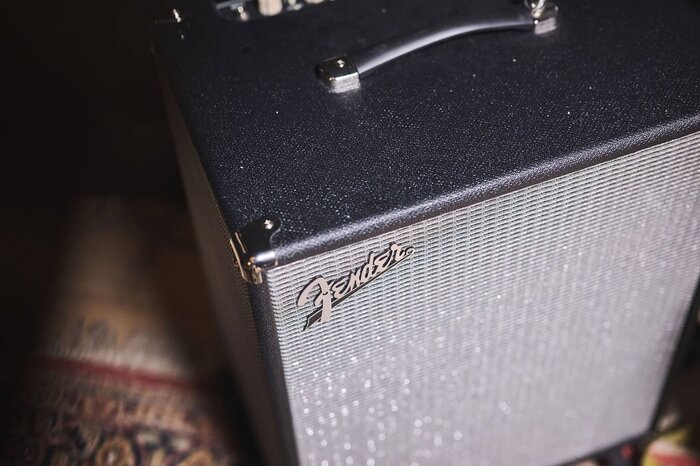
Guitar and bass amps can be quite directional, especially in the mid and high frequencies.
If the speaker is pointing at the player’s knees, that musician may not hear the same sound as someone standing several metres directly in front of the amp.
Putting the amp on a stand, tilting it or simply creating more distance between the amp and the musician can make it much easier to hear what it is actually producing.
This is a good example of the difference between:
producing more sound
and
hearing the sound you already have more clearly.
Before adding more decibels, try moving the sound source.
A small change in distance, angle or height can sometimes solve a problem that initially looked like a lack of power.
Bass and drums need to hear each other clearly
Because they very often work together to create the rhythmic stability of the song.
The kick and bass, for example, both contribute to the low-end foundation and movement of a track. That does not mean they always have to play the same thing, but they need to hear and react to each other.
If the drummer cannot hear the bass properly, they lose an important part of the information that helps them feel how the rhythm section is moving.
Conversely, the bass player needs to hear the kick, snare and rhythmic subdivisions of the drums clearly.
That is why bringing these two sources closer together musically — through their physical position or the direction of the bass amp — can be much more useful than simply making the bass louder across the whole room.
Again, the goal is not:
everyone must hear everything equally loudly.
The goal is:
everyone must clearly hear what they need in order to play their part in the band.
If the singer cannot hear themselves, find out why first
A singer who can no longer hear themselves is often the first obvious symptom of a poor balance.
But that does not automatically mean the band is playing too loud.
Before turning the vocals up, try to understand why they are disappearing.
The problem may come from:
- the overall level of the band;
- where the speakers are positioned;
- where the singer is standing;
- the direction of the microphone;
- an amp sending too much sound towards the singer;
- certain frequencies taking up too much space;
- or a combination of several of these factors.
So avoid the automatic logic:
“I can’t hear myself → turn my microphone up.”
The better question is:
“What is stopping me from hearing myself?”
Avoid feedback before pushing the vocals louder
If you simply keep increasing the microphone level, you will often reach another limit: feedback.
The principle is fairly simple.
A speaker plays the singer’s amplified voice. If enough of that sound comes back into the microphone, it goes through the system again, comes out of the speaker again, re-enters the microphone and creates a loop.
That is the familiar squeal or low howl of feedback.
The position of the microphone relative to the speakers is therefore very important.
In practice:
- avoid pointing the microphone towards a speaker;
- avoid standing unnecessarily close to a speaker carrying your vocal;
- keep the microphone reasonably close to your mouth while singing;
- find a better position before increasing gain or volume again.
If one specific frequency still starts resonating even with sensible positioning, a small EQ adjustment can sometimes give you a little more level before feedback appears.
But EQ comes after the obvious placement and level problems, not before them.
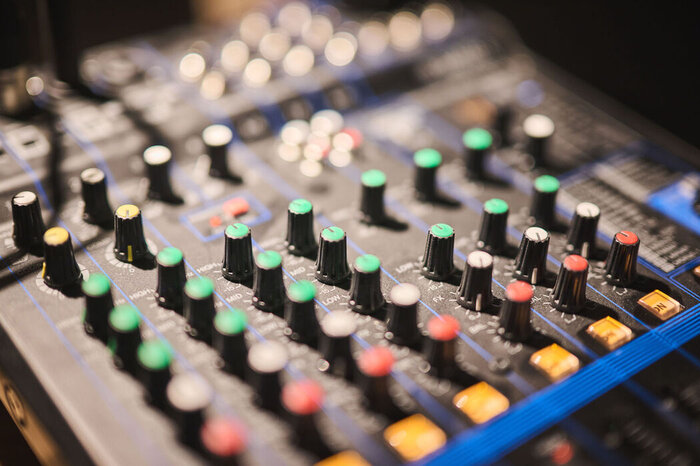
In Plug The Jack studios, our Help section also explains how to use the mixing console for vocal microphones and PA.
EQ can help, but it should not be your first fix
Yes, but it should not be the first thing you reach for.
Guitar, keyboards and vocals can occupy some of the same frequency areas. Even when they are not extremely loud, they can partially mask each other.
In some cases, a small EQ adjustment on an amp or on the vocals can create more space.
But EQ should not be used to repair a rehearsal where:
- all the amps are too loud;
- nobody is positioned properly;
- speakers and microphones are pointing in the wrong directions;
- everyone is playing without listening to the others.
Start with the playing, the volume and the positioning.
Use EQ afterwards to refine the balance.
This distinction matters: you can have a volume problem, but you can also have a problem with space in the sound.
Those are two different problems.
When the band really is playing too loud
After working on positioning, amp direction, vocals and a few simple settings, one very practical question remains:
Can everyone be heard properly?
If the answer is still no and the PA has to be pushed closer and closer to feedback simply to keep the vocals audible, the overall level of the band has probably become too high.
At that point, the answer is no longer to turn something else up.
You need to come back down.
The guitar can play slightly quieter. The bass player can adjust their level. The drummer can adapt their dynamics to the room.
Then the band listens to the whole sound again.
A good balance is not a perfect mix
A rehearsal is not a mixing session.
You do not need to spend twenty minutes searching for the perfect frequency setting for every instrument before playing a song.
The goal is much simpler:
- everyone can hear themselves and the others well enough;
- the vocals remain present;
- nobody is constantly covering everyone else;
- musicians who depend on each other can hear each other clearly;
- the band can play without constantly thinking about volume.
A successful balance becomes almost invisible.
Once that balance is in place, the next question is how to use your time together well: read How to rehearse effectively as a band.
Once nobody is constantly thinking:
“I can’t hear myself”
or
“They are far too loud”,
you can get back to what actually matters: the music.
So how do you hear each other properly in rehearsal?
Start quieter than your first instinct suggests.
Bring the instruments in gradually and listen to the band as a whole at every stage.
Do not automatically turn up an amp because its player cannot hear it: first check where it is and who it is pointing towards.
Position musicians according to their musical relationships. Bass and drums need to be able to work together. The other musicians need to hear important cues from the guitar, keyboards or other instruments. And the vocals need to exist within the band without the PA constantly being pushed to the edge of feedback.
If something disappears, first ask why before making it louder.
Because a good rehearsal is not one where everyone succeeds in imposing their own sound.
It is one where everyone hears enough of the others to build their own sound with them.
